Notes
Working notes on generative models, computer graphics, mathematics, and physics — written to think clearly.
2026
Hamiltonian, Action, and Path Integral
Classical mechanics can be organized around force, action, or energy. The Hamiltonian—energy on phase space—turns out to be the object that survives into quantum theory as the generator of time evolution on Hilbert space, while the action reappears as the phase weighting every path in the path integral. Following these two threads, together with the Poisson-bracket-to-commutator correspondence and the symmetry–conservation link, leads through quantization, the harmonic oscillator, statistical mechanics, quantum field theory, renormalization, and effective field theory.
Read
How Robots Learned to See, Understand, and Act
Vision-Language-Action models are transforming robot learning from a collection of task-specific controllers into general-purpose embodied agents. Rather than treating VLA as a single model architecture, we examine it as a sequence of responses to increasingly difficult questions: how robots understand tasks, how semantic knowledge becomes continuous action, how policies operate over long horizons, and how they improve beyond static demonstrations.
Read
From the Law of Large Numbers to Optimal Strategies: Proving Upper and Lower Bounds in Stochastic Processes
By applying concentration inequalities like Hoeffding’s, we derive deterministic bounds for uncertain processes, providing the foundation for UCB and TD learning.
Read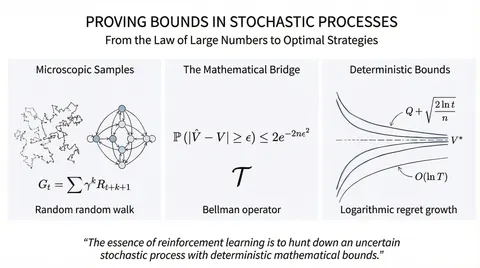
2025
第一性原理分析热力学和统计力学
Statistical mechanics is built upon the postulate of equal probability, which bridges deterministic microscopic mechanics and macroscopic thermodynamics. This foundation allows for the derivation of entropy and temperature, ultimately unifying classical and quantum descriptions through ensemble theory.
Read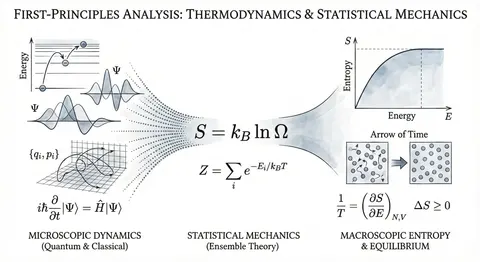
2024
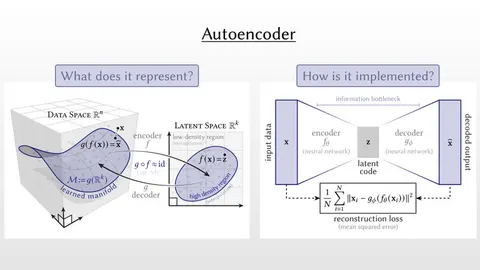
An Introduction to Variational Autoencoders
Analyzed the difficulty in deep latent variable models where the marginal likelihood is intractable and cannot be directly optimized, and introduced the framework of variational inference, where an encoder is used to approximate the true posterior distribution, thereby transforming the problem into the optimization of the Evidence Lower Bound (ELBO). Applied the reparameterization trick to enable gradient-based optimization of the ELBO by making the sampling process differentiable, and ultimately achieved end-to-end training of the entire generative model, including both the encoder and the decoder.
Read